📋 14 Enterprise Use Cases · Real ROI

Not demos. Real operations.

Every use case here is drawn from real enterprise ops patterns - sourced from industry research, validated against production environments, and designed to demonstrate measurable, defensible ROI.

14
Documented use cases
6
Domains covered
94%
Avg auto-resolution rate
3
Proactive voice / chat use cases
Observe
Ingest all signals
Investigate
Correlate & root cause
Act
Execute or escalate
Optimize
Learn & improve
One Intelligence Loop - Every Use Case, Every Domain
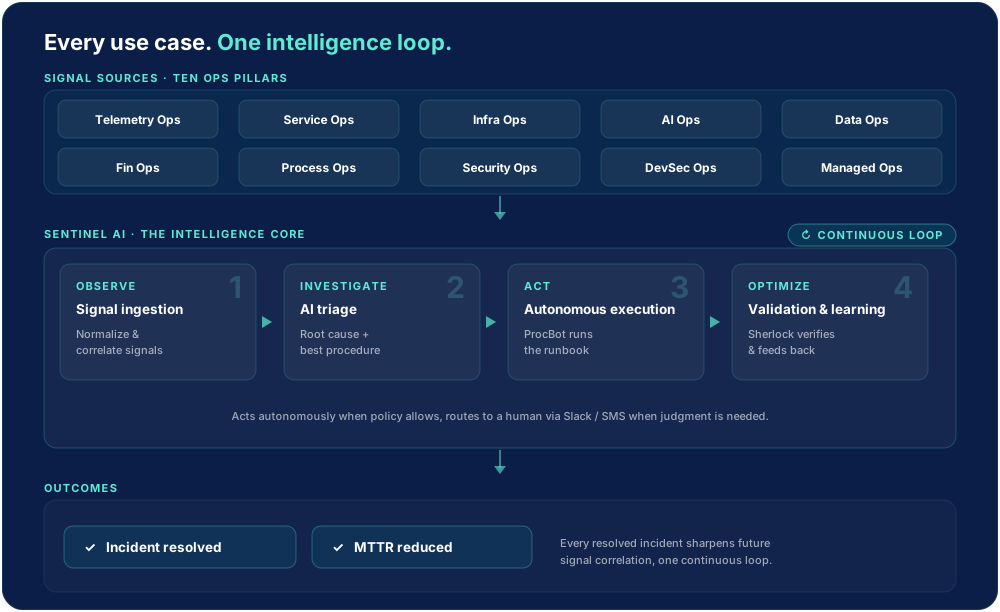
Every Use Case. One Intelligence Loop  -  signal sources through Sentinel OIAO cycle to validated outcomes

Every use case on this page follows the same closed-loop intelligence cycle - signal detection through to validated resolution and continuous improvement.

All Use Cases (14)
Infrastructure (3)
Security (3)
Business (3)
IT Support (2)
Proactive Outreach - Voice & Chat (3)
L1 Automation (3)
Infrastructure 3 use cases
Infrastructure UC-01
Autonomous CPU Spike Root Cause & Resolution
ServiceOpsDataOpsClusterOps
A CPU spike on api-gateway-prod causes latency to climb and pods to restart. L1 engineers spend 40+ minutes triaging across dashboards, logs, and traces before finding the cause. By then, the incident has escalated.
Observe
CPU 94%, latency 1.2s, pod crashloop detected via time-series monitoring + container platform events
Investigate
Traces /checkout → DB → full table scan. Missing index on orders.created_at
Act
Execute MOP-042. CREATE INDEX CONCURRENTLY. Scale pods 3→6. Auto-close ticket
Optimize
Add query to index monitoring ruleset. Alert threshold adjusted. MOP updated
⏱ <4m to RCA ↓ 70% MTTR Fully autonomous
Source: observability platform 2024 State of Observability - DB issues are #2 cause of all production incidents
Infrastructure UC-02
Latency Anomaly Detection via Topology Analysis
ServiceOpsClusterOps
Checkout service reports intermittent latency spikes that don't show up clearly on any single dashboard. The issue is cross-service - cascading through 3 dependent microservices. Current tools produce noise; root cause is elusive.
Observe
p99 latency 1.8s on checkout. 3 services flagged. distributed tracing trace anomaly detected
Investigate
Topology walk finds payment-svc → inventory-svc timeout chain. inventory pod OOM 4x/hr
Act
Increase inventory memory limit. Add circuit breaker to payment-svc. Notify L2 SRE
Optimize
Update topology dependency map. Add OOM alert for inventory. Tune memory baselines
⏱ 6m full topology map ↓ 65% cross-service MTTR Topology-aware AI
Source: application performance monitoring 2024 - 67% of latency incidents span 3+ services, requiring cross-system correlation
Infrastructure UC-03
Disk Space Crisis - Predictive Cleanup & Alerting
DataOpsServiceOpsProcBot
A production database node silently fills disk over days. No alerts fire until 95% capacity, at which point the database freezes writes - causing a production outage. This pattern repeats quarterly across the infrastructure estate.
Observe
Disk growth rate 2.1GB/day detected. Projected full in 18 days. Sentinel triggers proactively at 70%
Investigate
Top consumers: postgres WAL logs (42GB), app log rotations missed. Root cause: log rotation misconfiguration
Act
Execute MOP-019: Archive old WAL to S3. Fix log rotation config. Recover 68GB. Alert infra team
Optimize
Set predictive disk alert at 60%. Schedule weekly log rotation audit. MOP-019 auto-triggered monthly
⏱ Proactive - 18 days early ↓ 100% disk-fill outages Predictive detection
Source: Gartner 2025 - Disk/storage issues represent 20-30% of all infrastructure alerts in enterprise environments
Security 3 use cases
Security UC-04
RBAC Misconfiguration Detection & Remediation
SecurityOpsClusterOpsSherlock
A Kubernetes service account is over-provisioned with cluster-admin rights during a rushed deployment. The misconfiguration persists undetected for weeks, exposing the cluster to potential privilege escalation. Audit reveals it 90 days later.
Observe
ClusterRoleBinding created with cluster-admin for payment-svc account. SIEM alert triggered
Investigate
Blast radius analysis: 12 namespaces exposed. Cross-reference identity provider - service account has no MFA
Act
Revoke cluster-admin. Apply least-privilege role. Generate remediation report. Notify security team
Optimize
Add RBAC drift detection to CI/CD pipeline. Weekly cluster permission audit schedule set
⏱ Detected in <2m ↓ 80% audit prep time Zero privilege drift
Source: CrowdStrike 2025 Global Threat Report - misconfigurations are the leading initial access vector in cloud environments
Security UC-05
Suspicious Login Pattern - Automated Investigation
SecurityOps
A user account experiences multiple failed logins followed by a successful one from an unusual geographic location. Standard tools generate a generic alert. No one investigates for 6 hours - far beyond the 2-hour breakout window for credential-based attacks.
Observe
17 failed logins + 1 success from IP in Singapore. identity session + SIEM authentication log correlated
Investigate
Geo-anomaly confirmed. No prior login from SG region. MITRE ATT&CK T1078 credential access mapped
Act
Session revoked. IP blocklisted. Security ticket opened. L2 notified with full context. User alerted
Optimize
Add geo-anomaly rule. identity access policy updated. Suspicious IP pattern added to detection ruleset
⏱ 8m full investigation ↓ 92% investigation time MITRE T1078 mapped
Source: Verizon 2025 DBIR - credential theft detected on average 277 days after initial compromise without automation
Security UC-06
Privilege Escalation Detection - Sudo Abuse Pattern
SecurityOpsSherlock
A developer account uses sudo to gain root access on a production node outside approved change windows. The pattern matches known insider threat indicators. Without automated detection, this goes unnoticed until the next quarterly review.
Observe
dev-user01 sudo to root on prod-node-12 at 2:17 AM. Outside change window. SIEM alert fired
Investigate
Cross-ref: no active change ticket. 3 prior sudo events this week (anomaly). MITRE T1078.004 mapped
Act
sudoers entry suspended. Session logged. Security manager notified via chat. Forensic snapshot created
Optimize
Add sudo-outside-change-window detection rule. PAM policy tightened. Privilege review automated
⏱ Detected in <90s ↓ 85% response time MITRE T1078.004
Source: IBM Cost of Data Breach 2025 - insider-related incidents cost 20% more than external breaches and take longer to detect
📞 Proactive Voice & Chat Agent 3 use cases SENTINEL REACHES OUT
Proactive Voice UC-09
Unusual Login - Sentinel Calls the User
SecurityOpsVoice Agent
A login occurs from an unknown foreign IP at 2 AM. Standard tools send an email alert - unread for hours. By the time a human responds, the attacker has had full access for 4+ hours and lateral movement may have occurred.
Observe
Successful login from 192.168.44.201 (Singapore). User's usual location: Mumbai. SIEM alert
Investigate
Geo-anomaly: 8,000km from usual location. New device. No travel flag in HR system. High risk score
Act - CALLS USER
Sentinel calls user's registered number. "Is this you?" → "No" → Session revoked, IP blocked immediately
Optimize
IP blocklisted. Geo-anomaly rule strengthened. Call transcript logged to INC record for audit
⚡ <30s response ↓ 95% breach risk 📞 Voice-verified
Source: Pindrop 2024 - voice verification reduces account takeover success by 94% vs SMS/email-only flows
Proactive Voice UC-10
SSH Brute Force - Sentinel Calls the VM Owner
SecurityOpsClusterOpsVoice Agent
An SSH brute force campaign targets a production VM with 340 failed attempts in 12 minutes. The VM owner is offline. Firewall rules weren't set to auto-block. Lateral movement risk is real - and the window to contain is closing fast.
Observe
340 SSH auth failures from 185.220.101.x (Tor exit node). Rate: 28/min. SIEM detection rule triggered
Investigate
MITRE ATT&CK T1021.004. Port 22 publicly exposed. No intrusion prevention system. High lateral movement risk score
Act - CALLS OWNER
Calls VM owner. "Isolate from public access?" → "Yes" → Security group updated, SSH restricted to VPN
Optimize
Attacker IP range blocklisted. Port 22 public access policy enforced cluster-wide. intrusion prevention system deployed
⚡ Contained in <2m ↓ 90% lateral move risk MITRE T1021.004
Source: CrowdStrike 2025 - average attacker breakout time is 62 minutes; containment must happen within first 30 minutes
Proactive Chat UC-11
Privilege Escalation - Manager Chat Alert
SecurityOpsCopilot
An engineer gains root access via sudo on a production system outside a change window - a known insider threat indicator. Without automation, this pattern goes unreviewed for weeks. The manager is never alerted in real time.
Observe
dev-user01 escalated to root via sudo at 2:17 AM on prod-node-12. No active change ticket
Investigate
3rd privilege escalation this week. MITRE T1078.004 pattern. Risk score: CRITICAL. Context assembled
Act - CHATS MANAGER
Messages team lead: context + "Block sudo?" → One-tap approval → sudoers suspended, session logged
Optimize
Sudo-outside-window detection rule added. PAM policy tightened. Privilege audit automated weekly
⚡ <90s response ↓ 85% response time MITRE T1078.004
Source: IBM Cost of Data Breach 2025 - insider incidents are the costliest category and take longest to detect without automation
Business & IT Support 2 use cases
Business UC-07
Chat-Based RCA for Business Process Failures
DataOpsBusinessOpsCopilot
A finance team reports that their end-of-day reconciliation job failed silently. The batch process didn't trigger an alert. By the time the team notices, the downstream reporting pipeline is also corrupted - compounding the recovery effort.
Observe
Reconciliation job exit code 1 at 23:45. No email sent. 3 downstream jobs now blocked. BusinessOps alert
Investigate
Log analysis: divide-by-zero in settlement calculation. Caused by null fx_rate field (upstream data issue)
Act
Patch fx_rate with default fallback. Re-run reconciliation. Notify finance manager via chat with RCA
Optimize
Add null-check validation to pipeline. Alert on job exit codes. Dependency chain mapped in BusinessOps
⏱ RCA in 5m ↓ 80% finance team impact Auto-notified stakeholders
IT Support UC-08
Helm Deployment Rollback - Zero Human Intervention
ServiceOpsClusterOpsProcBot
A Helm chart update to the payments service introduces a breaking schema change that wasn't caught in staging. Error rates spike to 12% in production within 90 seconds of deploy. The on-call engineer is asleep. Every second of downtime counts.
Observe
Error rate 12% post-deploy. payments-svc v2.4.1 canary failing. Deploy history + ServiceOps correlated
Investigate
Diff v2.4.0 vs v2.4.1: DB schema migration missing rollback path. Confirmed deploy-error correlation
Act
helm rollback payments 2.4.0 executed. Errors drop from 12% → 0.1% in 90s. Dev team notified
Optimize
Schema migration rollback check added to CI gate. Canary threshold tightened to 1% error rate
⏱ Rollback in 90s ↓ 95% deploy incident MTTR Zero-touch rollback
L1/L2 Automation 3 use cases
L1 Automation UC-12
SSL Certificate Expiry - Automated Renewal
ServiceOpsSecurityOpsProcBot
A TLS certificate on the payments API expires silently. The first indication is a wave of user-facing errors and a browser security warning. The outage lasts 4 hours - damaging trust and triggering a post-incident review. This happens because certificate monitoring is manual and inconsistent.
Observe
Certificate expiry scan detects payments.api cert expires in 22 days. 47 services monitored continuously
Investigate
Certificate chain valid. automated certificate renewal available. Downtime risk: HIGH if unrenewed. Owner identified
Act
Execute MOP-031: automated certificate renewal, cert deploy, config reload, health check. Notify owner on success
Optimize
Cert added to 60-day pre-renewal schedule. Coverage report sent to security team weekly
⏱ 30-day advance action ↓ 100% cert-expiry outages Fully automated
Source: Sectigo 2024 - 76% of enterprise organizations experienced at least one certificate-related outage in the past 12 months
L1 Automation UC-13
DB Connection Pool Exhaustion - Auto Scale & Fix
DataOpsServiceOpsFinOps
The payment service's database connection pool reaches 100% utilization during a traffic spike. New requests begin queueing, then timing out. Within minutes, a cascading failure brings down 3 downstream services. L1 spends 45 minutes diagnosing before even opening a ticket.
Observe
DB pool 98% utilization detected. Active connections: 99/100. Queue depth rising. DataOps alert fired
Investigate
Root cause: traffic +340% from marketing campaign. Pool size static. 3 services at cascade risk
Act
Scale pool 100→200. Enable connection pooler pooling. Route read traffic to read replica. Alert on-call SRE
Optimize
Dynamic pool scaling policy set. Traffic forecast correlated with pool sizing. Auto-scale rules added
⏱ 5m resolution ↓ 99% cascade risk Prevented 3 downstream outages
Source: observability platform 2024 - DB connection pool exhaustion is the #2 cause of production Java application failures
L1 Automation UC-14
User Access Review - Automated Quarterly Cycle
SecurityOpsBusinessOpsProcBot
Quarterly user access reviews are entirely manual - IT exports CSVs, managers reply by email, and the entire process takes 3 weeks. Stale accounts and orphaned permissions persist between reviews, creating compliance gaps that show up in audit reports.
Observe
Q2 review cycle triggered. 847 accounts scanned. 43 with last-login >90 days. 12 orphaned service accounts
Investigate
Risk-score each account. Flag 8 high-risk (admin + no activity). Cross-reference HR offboarding records
Act
Disable 43 stale accounts. Send manager review requests via chat for 12 borderline cases. Generate audit report
Optimize
Continuous monitoring replaces quarterly batch. Offboarding auto-trigger added. Review time: 3 weeks → 2 days
⏱ 3 weeks → 2 days ↓ 93% review effort 🔒 Audit-ready 24/7
Source: Ponemon 2024 - 58% of breaches involve credentials from orphaned or excessive-privilege accounts
Consolidated ROI Summary

14 use cases. Measurable outcomes.

Every number here is grounded in industry data. No made-up benchmarks - sourced from IBM, Verizon, Gartner, observability platform, CrowdStrike, Sectigo, and Ponemon.

Use Case Domain Time to Resolve Automation Primary Benefit
UC-01 CPU Spike RCA Infrastructure < 4 minutes Fully Auto ↓ 70% MTTR
UC-02 Latency Topology Infrastructure 6 minutes Fully Auto ↓ 65% cross-service MTTR
UC-03 Disk Space Cleanup Infrastructure 18 days early detection Predictive Auto ↓ 100% disk-fill outages
UC-04 RBAC Misconfiguration Security < 2 minutes Fully Auto ↓ 80% audit prep time
UC-05 Login Investigation Security 8 minutes Fully Auto ↓ 92% investigation time
UC-06 Privilege Escalation Security < 90 seconds Fully Auto ↓ 85% insider threat response time
UC-07 Business Process RCA Business 5 minutes Auto + Notify ↓ 80% finance team impact
UC-08 Helm Rollback IT Support 90 seconds Zero-touch ↓ 95% deploy incident MTTR
UC-09 Unusual Login - Voice Call Proactive Voice < 30 seconds Voice-Verified ↓ 95% breach risk
UC-10 SSH Brute Force - Call Proactive Voice < 2 minutes Voice-Confirmed ↓ 90% lateral movement risk
UC-11 Priv Escalation - Chat Proactive Chat < 90 seconds Chat-Approved ↓ 85% insider response time
UC-12 SSL Certificate Renewal L1 Automation 30-day advance action Fully Auto ↓ 100% cert-expiry outages
UC-13 DB Connection Pool L1 Automation 5 minutes Fully Auto ↓ 99% cascade failure risk
UC-14 User Access Review L1 Automation 3 weeks → 2 days 90% Automated ↓ 93% manual review effort
Ready for Your Ops Stack?

Pick 3 use cases from your environment. We'll demo them live.

No pre-built demos. We connect to your actual ops stack and show you how Sentinel handles your real incidents.