Each pillar is purpose-built for its domain. Every pillar feeds Sentinel AI - the intelligence layer that connects, correlates, and acts across all of them.
Visualize every hop in your request chain - from API gateway to database query. ServiceOps reconstructs the full call graph from trace data, showing per-service latency, error rates, and dependency health in real time.
Logs from 12 services, correlated in milliseconds. When checkout fails, ServiceOps instantly shows which upstream service triggered the cascade - with timestamps and error context aligned across the full chain.
Identify slow queries, full table scans, and missing indexes - before they degrade user experience. ServiceOps tracks query execution time at the span level and links database bottlenecks to the services that trigger them.
P50, P95, P99 latency tracking. Error rate trending by service, endpoint, and deployment. Real-time alerting when SLOs are at risk - before the SLA is breached.
Node capacity, pod scheduling pressure, resource quota utilization - all in one view. ClusterOps identifies overprovisioned namespaces, underutilized nodes, and capacity risks before they cause CrashLoops.
When a pod crashes at 2 AM, Sentinel uses ClusterOps to autonomously inspect the failing pod - identifying OOMKilled events, exit codes, and error patterns from logs and events without waking an engineer.
Sentinel executes cluster management commands as part of autonomous investigations. Engineers can also trigger cluster management through Copilot in plain English - no syntax required. Results returned in structured, readable format.
Full visibility into network policies, ingress rules, and service mesh configuration. Critical for security - ClusterOps is what enables Sentinel to isolate a compromised server's SSH access in 90 seconds.
After every autonomous resolution or engineer-applied fix, Sherlock monitors the resolved signals for a configurable window. If the anomaly resurfaces - alert volume, error rate, security event - the incident is automatically reopened with a "recurrence detected" flag before it becomes an outage again.
Sherlock tracks incident patterns across time. When the same root cause appears three or more times, it flags the issue as "band-aid resolved" and escalates to L2 for a permanent fix - with the full pattern history as evidence. Repeated firefighting stops.
Every ProcBot MOP execution is scored by Sherlock: did the procedure close the incident? Did it recur? How fast? Over time, Sherlock surfaces the MOPs that work and flags the ones that don't - giving your team a continuously improving runbook library without manual audit.
Sherlock compares the stated root cause in the closed RCA against actual service telemetry post-resolution. If the service behaviour diverges from the expected stable state, Sherlock challenges the RCA and triggers a re-investigation - ensuring Sentinel's analysis is empirically correct, not just plausible.
Enterprise-grade SIEM with built-in log analysis, file integrity monitoring, vulnerability detection, active response, and container security - built on proven open-source intelligence foundations with a modern React UI surfaced through Sentinel.
Every alert mapped to the MITRE ATT&CK framework. Understand not just what happened, but the technique, tactic, and kill chain stage - giving security analysts immediate context for prioritization.
Unusual login from a new country? SSH brute force on a production server? Sentinel doesn't wait for an analyst - it calls the affected user or VM owner directly, confirms the threat, and acts in seconds.
PCI-DSS, HIPAA, SOC 2, ISO 27001, GDPR - out-of-the-box compliance rules. Sentinel generates audit evidence packages automatically. SOC 2 evidence collection: from 3 weeks to 30 minutes.
Monitor ETL and ELT job completion, failure rates, and execution duration in real time. When a nightly data load fails at 02:00 AM, Sentinel identifies the cause - network timeout, schema drift, or upstream dependency - before anyone arrives in the morning.
Track null rates, value distributions, and row count anomalies across datasets. DataOps detects when a source system starts sending malformed records - before those records corrupt downstream analytics or machine learning models.
Real-time tracking of ingestion lag for streaming and batch pipelines. Sentinel alerts when Kafka consumer lag exceeds thresholds, when batch windows are at risk, or when throughput drops below SLA.
DataOps maps pipeline dependencies - which downstream dashboards, reports, and ML models rely on each dataset. Sentinel uses this lineage to calculate the blast radius of a pipeline failure before notifying the right teams.
Track cloud spend across AWS, GCP, and Azure in real time - by team, service, environment, and resource type. No more surprise bills. FinOps surfaces spend trends daily so finance and engineering stay aligned.
Sentinel detects abnormal spend patterns before they compound. A forgotten load test running for 6 hours, an autoscale event that never scaled back down, a debug log level pumping data into S3 at 100x normal rate - caught in hours, not at month-end.
FinOps analyzes CPU, memory, and I/O utilization patterns to identify overprovisioned resources. Sentinel generates rightsizing recommendations with estimated savings - cross-referenced with ClusterOps to ensure capacity safety before downsizing. Every rightsizing action is then validated by Sherlock: confirming performance held and the savings persisted over a 24-hour window.
Allocate cloud costs to teams, products, and clients with tag-based showback reports. For professional services firms managing multi-tenant platforms, FinOps provides per-client cost visibility that maps directly to engagement billing.
ProcBot is the single source of truth for all procedures. Investigation MOPs guide Sentinel's diagnostic reasoning when facing unknown failures. Execution MOPs are the step-by-step remediation scripts Sentinel runs to fix them. Both types stored, versioned, and continuously improved by Sherlock.
ProcBot natively executes Ansible playbooks and shell/bash scripts - your existing automation library, unchanged. Bring your current runbooks: ProcBot wraps them with observability, audit logging, conditional branching, and rollback logic. Nothing rewritten, everything enhanced.
For high-impact procedures, ProcBot triggers a human approval step. Sentinel presents the procedure, the evidence, and the risk assessment - and waits for confirmation before executing. Approval, action, and evidence are all audit-logged for compliance.
Procedures aren't linear scripts - they're intelligent workflows. ProcBot supports conditional branching (if disk > 90% and service is critical, execute escalation path), timeout-based fallback, and multi-step approval chains. Every edge case handled, every action logged.
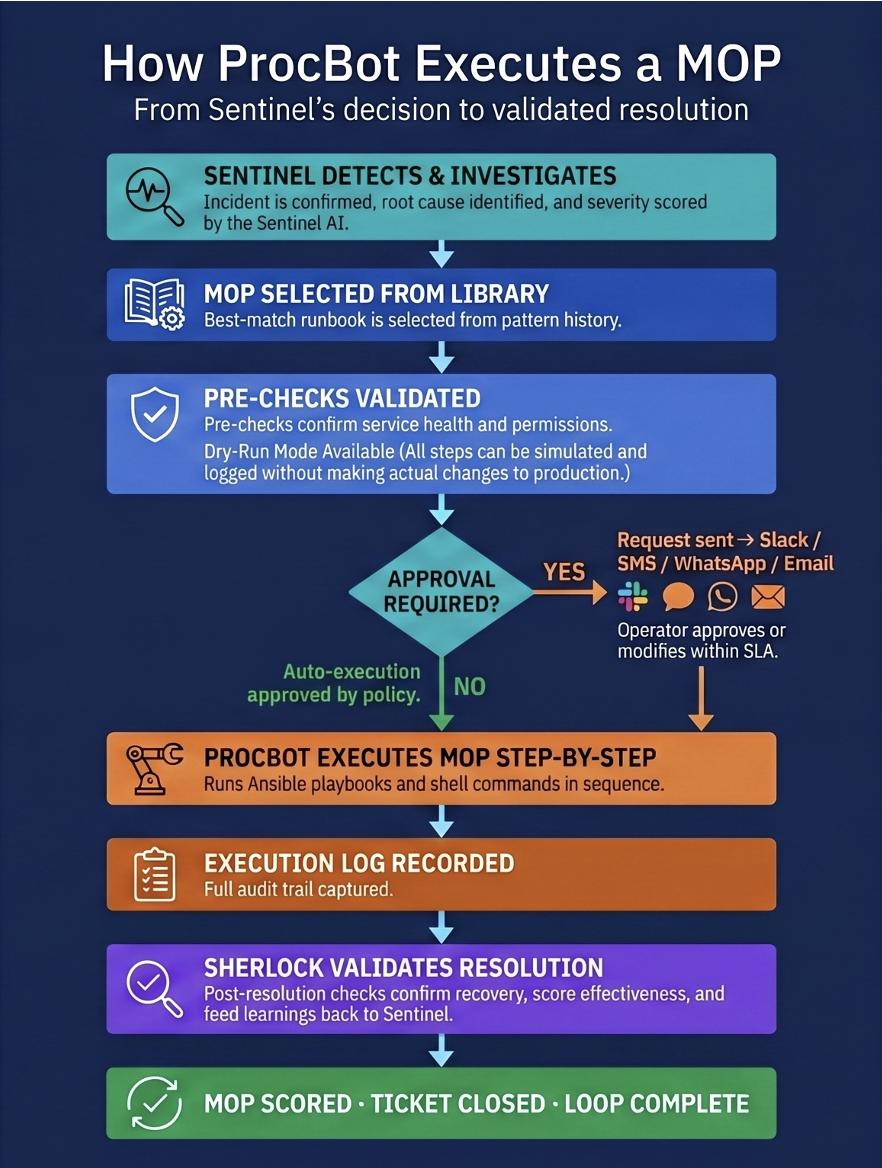
Every MOP step is logged, auditable, and scored by Sherlock - creating a continuously improving, self-optimising procedure library.
Encode your organization's tribal knowledge as structured procedures. RBAC debugging, client onboarding, login failure investigation, user provisioning - any business process can be turned into a MOP that Sentinel follows, giving every L1 agent the power of your best L2 expert.
BusinessOps connects directly to your identity provider to debug permission issues. When a user can't see a module, Sentinel queries the permission model, compares with a working reference user, and identifies the exact missing groups - in 90 seconds, no L2 needed.
New client engagement or system onboarding? BusinessOps validates every provisioning step against a MOP - identity provider realm setup, module access, SIEM rules, network policies. Misconfigurations identified before the client arrives.
The most common support tickets - "can't log in," "can't see this module," "how do I get access to X" - automated end-to-end. Sentinel investigates via MOP, delivers the diagnosis, and closes the ticket. L1 throughput multiplied without headcount.